Alumni Profile: The Human Firewall: Why Cybersecurity Needs UX
A profile of HCIM alum Kaush Ganesh
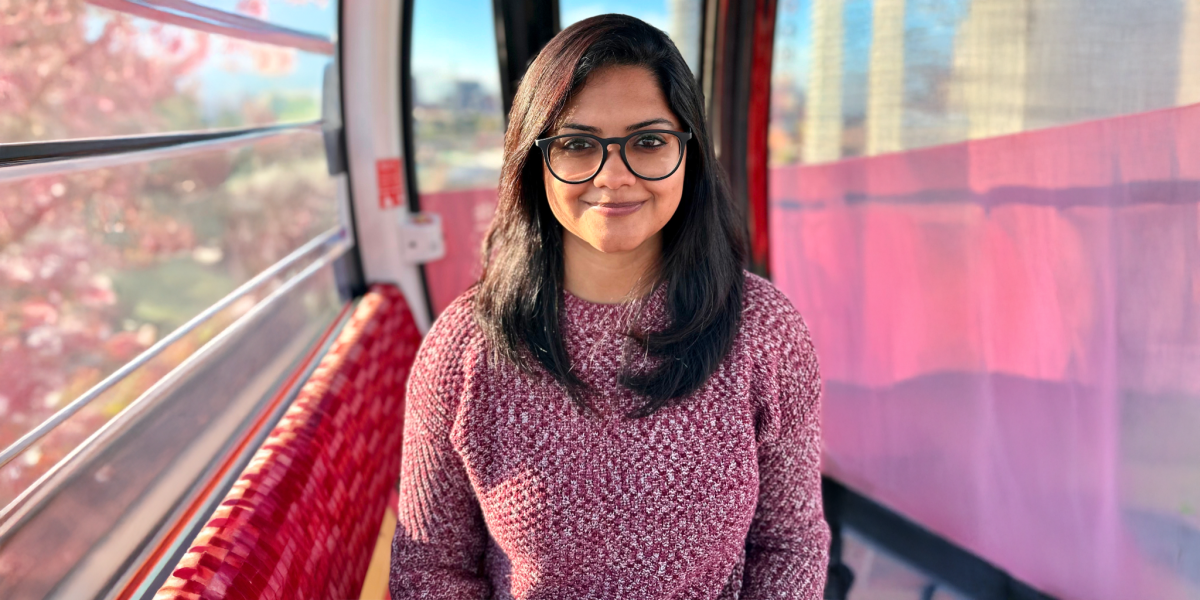
Kaush Ganesh, HCIM '20
For Kausalya (Kaush) Ganesh, a 2020 graduate of the MS in Human-Computer Interaction program at the University of Maryland College of Information, a childhood defined by movement—new friends, new schools, new languages every few years—laid the foundation for her career. “I grew up all over India. My dad’s job meant we moved every few years,” she recalls. “At first, it felt like I was just starting over several times, but it gave me this early curiosity about people and how to adapt.” This innate curiosity, paired with the community she found in Indian classical singing, shaped a drive to understand what connects people—a drive that would eventually find its professional home in UX research.
Today, Ganesh is a lead design researcher at Cisco, leading UX research in the complex field of cybersecurity. Her journey, however, was not a straight line. She started with a bachelor’s degree in electrical engineering and went on to explore various roles in professional services engineering and marketing. It was the discovery of HCI that provided the missing link. “Once I discovered UX, I realized that I could combine all the technical thinking [and] my curiosity about people and put that together.”
In her current role, Ganesh operates on two key fronts: exploring how emerging technologies like artificial intelligence (AI) can shape security and leading an accessibility research program to push for greater inclusion. No two days look the same for her. “Some days I’m in workshops with designers, engineers, and product managers ideating what the next solution could be, and other days I’m crafting a research plan to uncover gaps in how users actually experience our solutions.” At its core, it’s a dual mission: advocating for users and driving human-centered business outcomes.

Kaush Ganesh, HCIM ’20
One of the most rewarding accomplishments of her career came recently when she was invited to speak about accessibility research at the USENIX Security Symposium, a premier conference for academics and industry leaders. “People really leaned in, asked a lot of thoughtful questions, and wanted to know how they could start making their own work more inclusive,” Ganesh says. “One person came up after and said, ‘I’ve never heard someone describe security pain points in this way before.’ That moment of connection and seeing someone shift their perspective went way beyond just the talk itself.”
This focus on accessibility is a professional passion, and she has a clear perspective on why it is often overlooked. “I think with accessibility, a lot of the time people assume that accessibility [is] for people with disabilities and they don’t understand that accessibility is something we all need,” she explains. “One’s arm could be fractured, or they could be holding too many grocery bags to operate the thing in front of them… Anything that’s created with accessibility in mind is going to impact everyone’s life in a meaningful way.” Shifting this mindset, she notes, is a significant challenge, especially in large companies where building for the perceived majority often takes precedence.
Becoming a UX Researcher
Reflecting on her time at INFO, Ganesh points to the blend of “structure and flexibility” as crucial. She valued the freedom to explore courses in entrepreneurship and business. Her work in the Health, Aging and Technology lab, led by INFO Associate Professor Amanda Lazar, was particularly formative. “My understanding of qualitative research analysis and synthesis is really rigorous thanks to the mentorship that I received,” she notes. Her thesis, which evolved into a paper accepted at the ACM SIGCHI Conference on Computer-Supported Cooperative Work & Social Computing (CSCW), focused on understanding the experiences of people with chronic conditions such as fibromyalgia and migraine, and on how technology can help either keep them hidden or help them explain their condition.
Another standout experience was a project for the course “User Experience Research Methods.” Her team partnered with the Stamp Student Union to study how people discover events. Their recommendation to use QR codes with tracking was swiftly implemented. “It was our team’s first glimpse into how research can drive real change.”
For current students and recent graduates, Ganesh offers advice that reframes a common anxiety. “The truth is, most of us graduate with similar skills. What sets you apart is how you define your values and how you tell your story.” She encourages a shift in mindset when viewing job postings: “Instead of being like, ‘am I qualified?’, a reframe to consider is, ‘can I see myself learn and grow into this role?’ Employers aren’t looking for a finished product. They’re looking for people who are invested in their own growth as part of the company.”
Outside of work, Ganesh continues to embrace learning and creativity, from DIY home renovation projects to trick training with her two Aussiedoodles. She has also recently found her way back to classical music, which has been “like reconnecting with an old friend.” This continual exploration, both personal and professional, underscores her core belief: in technology, as in life, keeping the human experience at the center is what truly moves ideas forward.
- Alumni Spotlight
- INFO News
- Profile
- HCIM
- Accessibility and Inclusive Design
- Health Informatics
- Human-Computer Interaction
- Information Justice, Human Rights, and Technology Ethics
- Machine Learning, AI, Computational Linguistics, and Information Retrieval
- Social Networks, Online Communities, and Social Media