Research
Driven by the pursuit of new ideas and big discoveries, faculty, researchers, and students at the UMD College of Information (INFO) are combining principles of information science with cutting-edge technology to foster access to information, improve information interfaces, and expand how information is used. We tackle significant, real-world information challenges from diverse perspectives such as communication, information retrieval, policy, computer science, education, archives, business, human factors, law, humanities, and more. Our discoveries empower, inspire, and connect individuals and communities.
EXPERTISE AREAS RESEARCH GROUPS PROJECTS
Research Community
70+ Faculty and Researchers, 88 PhD Students, 12 Research Labs/Centers
INFO Research Groups
Research Performance
$36M in Research Funding from 16+ Funders; 50 Active Grants; 12 NSF, IMLS or DARPA Career Grants
Browse Projects
#8 HCI Research USA
UMD for Research Performance in Human-Computer Interaction (Publications, Citations)
EduRank (external link, opens in a new tab)
#11 Research Spending USA
UMD in the USA for Research Spending, Public Universities
National Science Foundation HERD Survey (external link, opens in a new tab)
Internal College Research Funding
Internal College Research Funding provides limited financial support to INFO Faculty, Ph.D., and Master’s students who have exhausted all other available funding sources to improve their research efforts. It also supports collaborations in critical research areas through advancing Research Interest Groups. Proposal applications are accepted yearly on January 15th, April 15th, and September 15th. Ph.D. students may also apply for additional research funding under the Doctoral Student Search Award (DSRA). More information about the DSRA and its application process can be found on the INFO Scholarships & Awards landing page.
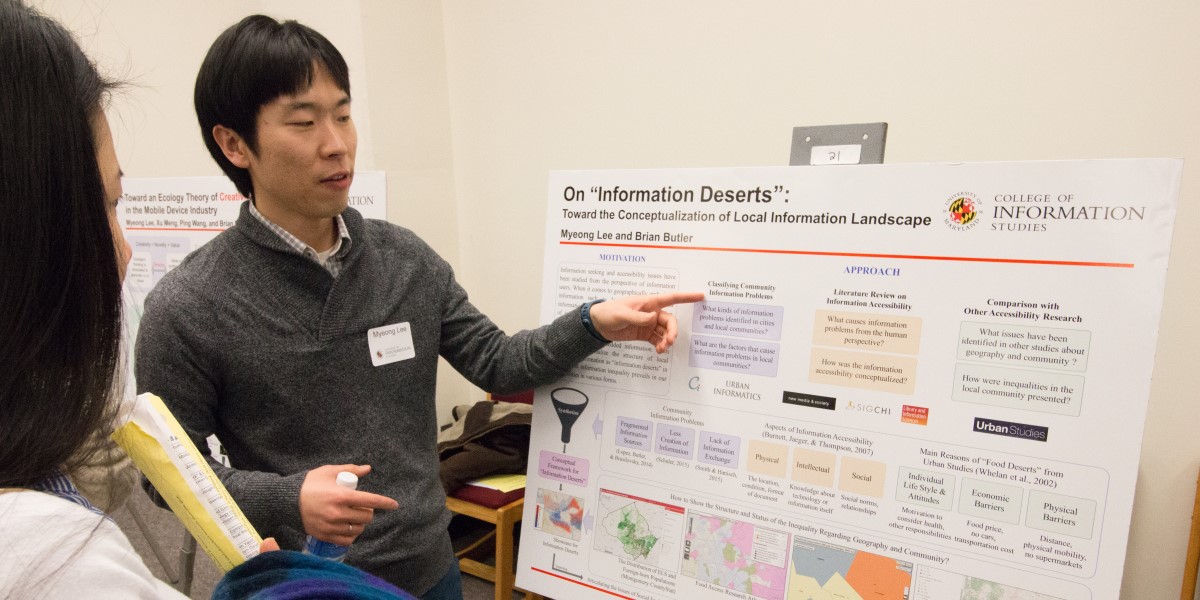
INFO PhD Student Presenting Research Poster
INFO Research News
Photo licensed by Adobe Stock
When the Feed Becomes the Front Line
April 15, 2026 | Laurie RobinsonA new generation of AI tools is changing how analysts and aid workers make sense of war in real time—if they can learn to trust what …