Offering libraries a powerful framework for proactive, community-centered crisis preparedness
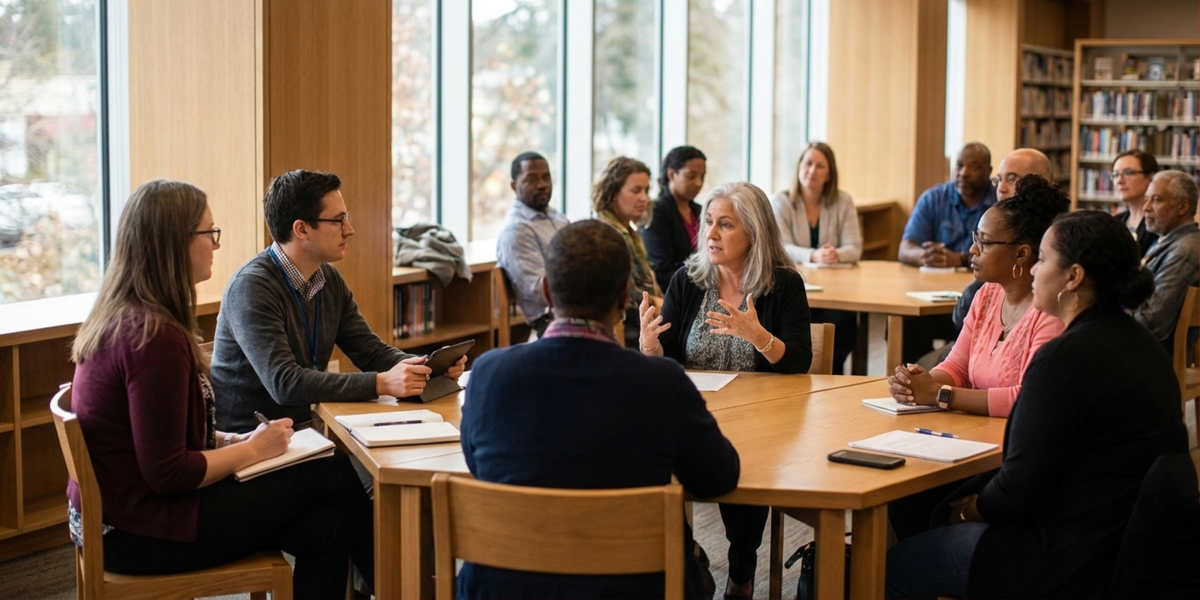
This image was generated using AI (Google Gemini)
COLLEGE PARK, MD — A new national resource is now available to help libraries prepare for major community emergencies—including pandemics, natural disasters, and societal crises—before they hit. Centering Community: Library Staff Responding to Crisis – A Field Guide, developed through the Ready NOW project, provides practical strategies and examples to help libraries support their communities before, during, and after disruptions of varying scale.
An initial version of the Field Guide was created and distributed in 2021 in response to lessons learned during the COVID-19 pandemic, when libraries struggled to serve communities that could no longer come into library buildings. As demand for information, technology, and local support surged, many libraries were forced to improvise.
“We realized that library staff really wanted to help, but just did not know how to help,” says Dr. Mega Subramaniam, professor at the University of Maryland College of Information (INFO) and principal investigator of Ready NOW. “It’s not so much what you do during a crisis—what you do before a crisis happens is even more important. If there’s no preparation, you’re just reacting in the moment.”
The Ready NOW team has released an updated Field Guide (December 2025), now available for download. This edition includes revised guidance informed by ongoing research.
Funded by the Institute of Museum and Library Services (IMLS), Ready NOW is a multi-year research and practice initiative that brought together library teams nationwide to rethink crisis readiness. Dr. Subramaniam and a multidisciplinary team (below) designed approaches that center community voice and adaptability.
Unlike traditional emergency manuals, the Field Guide does not offer a fixed checklist for crisis response. Instead, it introduces a set of non-sequential, iterative practices that libraries can revisit over time: building transformational community relationships, engaging in true co-creation, shaping internal capacity and policies, and embedding reflection into everyday work.
Dr. Subramaniam emphasizes that the framework challenges assumptions about what communities need. “When library staff respond based on assumptions rather than lived community experience, even well-intentioned efforts can miss the mark,” she says. “Without a community-centered mindset in place, libraries risk responding to a crisis in ways that don’t align with people’s actual needs.”
She also underscores the guide’s focus on true co-creation: “Co-creation isn’t about designing a service and asking for feedback at the end,” she says. “It’s about building relationships and trust from the start and centering the voices of those most affected. Real co-creation takes time—and it asks library staff to embrace vulnerability by acknowledging that we don’t already have all the answers.”
Among the practitioners whose experiences informed the guide is Tyler Hahn, director of the Cherokee Public Library in Cherokee, Iowa, who participated in the project’s first year and later served as a mentor to library teams nationwide. “This helped reframe our mindset about how to address issues in our community,” Hahn says. He notes that the approach strengthened the library’s position as a trusted community hub: “People now see the library as a place where, if we don’t know the answer, we know how to find that answer,” he says.
In addition to the Field Guide, the Ready NOW project has developed design session plans and facilitation materials that allow library teams to work through the guide collaboratively.
By centering community voices, the Field Guide positions libraries as institutions prepared in advance to serve their communities during crises.
Download the Field Guide now.
Ready NOW Project Team:
- Dr. Mega Subramaniam (principal investigator, professor, University of Maryland College of Information)
- Linda Braun (principal, The LEO Group)
- Nitzan Koren (doctoral candidate, University of Maryland College of Information)
- Dr. Sandra Hughes-Hassell (professor, University of North Carolina School of Information and Library Sciences)
Media Contact: Dr. Mega Subramaniam, mmsubram@umd.edu.
# # #
About the University of Maryland College of Information
Founded in 1965, the University of Maryland College of Information (INFO) is a leading research and teaching college in the field of information science, ranked #3 in the USA by the U.S. News & World Report. INFO faculty, staff, and students are expanding the frontiers of how people access and use information and technology in an evolving world—in government, education, business, social media, and more. The college offers top-ranked academic degree programs and leads cutting-edge academic and industry research, specializing in library and information science, digital curation, data systems and management, human-computer interaction, AI and machine learning, accessible and inclusive technology design, sociotechnical systems, and cybersecurity and privacy. Located just outside of Washington, D.C., INFO faculty, staff, and students have unmatched research, internship, and career opportunities. https://info.umd.edu/