UMD INFO College’s Lee Tiedrich Leads Global Efforts to Shape AI Policy
As UMD’s inaugural AIM Fellow, Tiedrich helps build the standards and systems needed to turn AI policy into effective practice
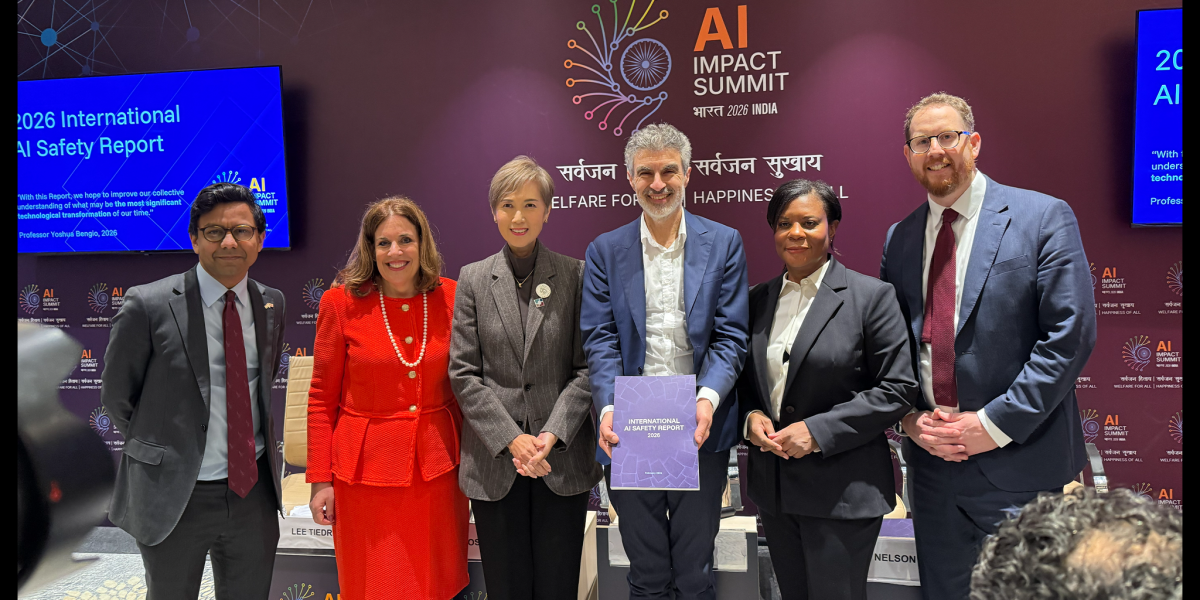
Left to right: UK Minister Kanishka Narayan, Lee Tiedrich, Singapore Minister Josephine Teo, Yoshua Bengio, Alondra Nelson, Adam Beaumont, Director of the UK AI Security Institute, present the International AI Safety Report at the AI Impact Summit in India.
In a fall semester course on algorithmic governance at the College of Information (INFO), students from computer science and information science worked through some of the most contested problems in AI policy—not in the abstract, but with the people who helped shape the frameworks themselves. One session focused on the National Institute of Standards and Technology (NIST) AI Risk Management Framework. The guest speaker was the former chief of AI at NIST. Students broke into groups, worked through a real-world hypothetical, and presented their findings for critique.
“We gave the students the opportunity to engage in real-world problems, learn from professors who approach it from very different disciplines, and then supplement that with great outside experts. The students were really creative,” says Lee Tiedrich, who co-taught the course. “We all learned a lot from each other.”
That kind of exchange is precisely what the Artificial Intelligence Interdisciplinary Institute at the University of Maryland (AIM) fellowship was designed to enable. Tiedrich, its inaugural fellow and visiting professor of the practice at INFO, has spent her career at the intersection of technology, law, and policy. The fellowship has given her a platform to bring that work directly into the classroom.
Building the Foundation for AI Governance
Beyond the classroom, Tiedrich is one of 24 senior advisers to the International AI Safety Report—a landmark effort commissioned at the first AI Safety Summit and chaired by Turing Award winner Yoshua Bengio. Tiedrich’s background spans electrical engineering, nearly 30 years of law practice, and extensive work with international policy organizations—a range that makes her unusually suited to the role.
Supported by more than 30 countries, the report seeks to establish a shared scientific foundation for understanding advanced AI: what the risks are, how mitigation efforts are evolving, and where important uncertainties remain. The most recent edition was released in February, timed to coincide with the India AI Impact Summit, where Tiedrich moderated a panel of global ministers and researchers.
“The report focuses on risks, but there are also a lot of benefits to the technology,” Tiedrich says. “People understanding it and learning how to use it and how not to use it—that’s really important. It’s going to be impacting all of us.”
A central idea in Tiedrich’s work, including her chapter on U.S. AI regulation in a new Springer Nature volume on the AI revolution, is that law alone cannot do all the work many people may want it to do. For rules to be implemented effectively, the infrastructure around them has to exist: testing frameworks, evaluation systems, shared standards, and assurance mechanisms that allow institutions to determine whether those rules are being followed. This structure also gives policymakers in different regions the flexibility to decide whether such rules should be voluntary or mandatory. It also helps foster more global regulatory interoperability when leaders in different jurisdictions disagree on the need for mandatory requirements.
Her analogy is the FDA. Public trust in prescription drugs does not depend on every individual understanding the science behind them. It depends on the existence of a system for testing, review, and oversight. For AI, the equivalent governance infrastructure is still being built.
“Sometimes having a law when nobody knows what to do to implement it doesn’t help as much,” she says.
At the same time, she notes, accountability does not begin only when new AI-specific legislation is passed. Existing legal frameworks already apply in many cases. Anti-discrimination law, consumer protection, and copyright law are all being tested in relation to AI. Litigation involving data scraping and fair use is expanding, and cases involving harms linked to AI interactions are beginning to reach the courts. Congress has also acted in at least one area, passing the Take It Down Act to address non-consensual intimate imagery.
“To bring a lawsuit, you don’t need a new AI law,” she notes. She also added that states are increasingly seeking to regulate AI given the federal government’s deregulatory approach.
The challenges of the next few years—building the evaluation systems, the testing frameworks, the shared standards that make real governance possible—will unfold in a field where the rules are still being written, and where the people writing them matter enormously. Through AIM, INFO is making sure it has a seat at the table.
- Faculty & Staff
- INFO News
- Partner & Industry News
- Research News
- Data Privacy and Sociotechnical Cybersecurity
- Future of Work
- Human-Computer Interaction
- Information Justice, Human Rights, and Technology Ethics
- Machine Learning, AI, Computational Linguistics, and Information Retrieval
- Artificial Intelligence Interdisciplinary Institute at Maryland (AIM)